
The Clash of Crowns: Rome, Israel, and the Revolution of the Word “Lord”
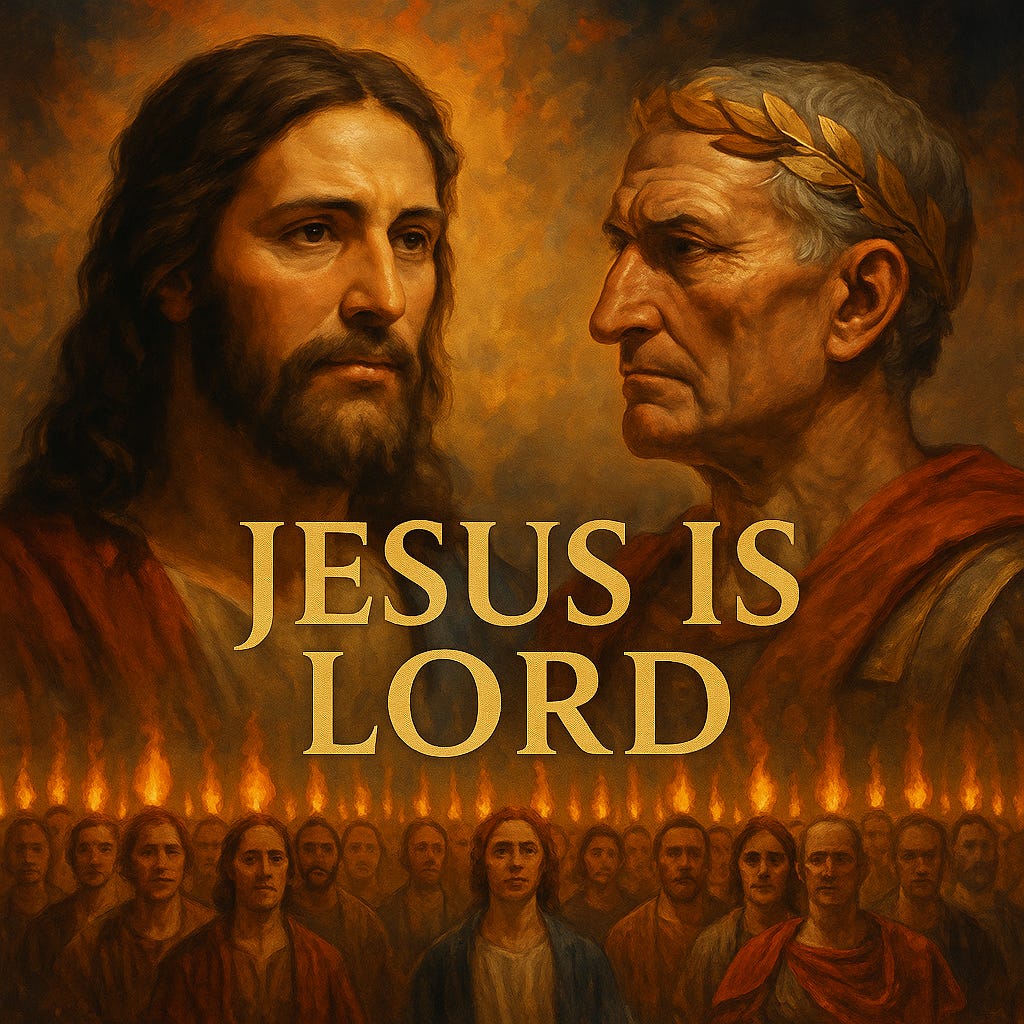
In the first century, beneath the marble colonnades of the Roman Empire, religion and politics were one. Caesar was not merely ruler; he was kurios: lord of land and sea, benefactor and savior of the world. His image adorned the coinage, his decrees shaped the conscience of nations, and his divinity was proclaimed in every province where incense rose to the imperial cult. The empire’s gospel was simple: “Caesar is Lord.”
Yet, in an obscure province called Judea, a handful of Galileans dared to whisper a subversive creed; short, scandalous, and incendiary: “Jesus is Lord.”
Those three words became the detonator that fractured the theological foundations of Rome. They were not spiritual niceties. They were a declaration of rebellion against the deification of power, the sanctification of tyranny, and the worship of men. When Peter stood at Pentecost and cried, “Let all the house of Israel know assuredly that God has made this Jesus, whom you crucified, both Lord and Christ,” he did not speak as a theologian seeking approval from the Senate; he spoke as a herald of the true Emperor of Heaven.
The Imperial Cult and the Apotheosis of Caesar
To understand the scandal of calling Jesus Lord, one must descend into the ideological machinery of Rome’s Imperial Cult. From Augustus onward, Caesars claimed divine filiation. They were called divi filius: “sons of the gods.” When Julius Caesar’s comet streaked across the night sky, the Senate deified him, and Augustus used the event as political gold. He, the adopted son of a god, would be the savior of the world, the bringer of Pax Romana, the peace that flowed from the sword.
Every city echoed this liturgy of power. In Myra, inscriptions hailed Tiberius as “the exalted god, lord of land and sea, benefactor and savior of the entire world.” Citizens took loyalty oaths declaring, “Caesar kurios.” It was not merely civic allegiance; it was worship.
Into this climate came the early Christians who refused to burn incense before Caesar’s image. Their defiance was not political sedition but theological conviction. For them, to bend the knee to Caesar as lord would be to betray the covenantal Name of God Himself.
Psalm 110 and the Cosmic Enthronement
Peter, in Acts 2, draws his sermon not from the wind of emotional zeal but from the deep reservoir of both Joel and David’s prophecies. “This is that which was spoken of by the Prophet Joel, ‘And it shall come to pass in the last days, saith God, I will pour out of My Spirit upon all flesh…” and “The LORD said unto my Lord, Sit at My right hand, till I make Thine enemies Thy footstool.”
This was no mere metaphor. In David’s Hebrew text, YHWH said unto my Adonai, God speaking to the One whom David himself called Sovereign. The right hand was not a seat of honor alone; it was the throne of cosmic authority. Thus, when Peter proclaimed that Jesus had ascended and sat at the right hand of God, he was declaring the inauguration of a kingdom higher than Rome and more enduring than marble.
This was not the apotheosis of a man through senatorial decree; it was the exaltation of the Incarnate Word by divine fiat. No council assembled to debate His worthiness, no senate convened to vote Him into divinity. No! Heaven itself crowned Him, declaring before angels and ages that the Holy One of Israel had robed Himself in flesh; that the Ancient of Days had walked among men; that Divinity, veiled in humanity, had revealed the radiant face of God to His creation.
The True Ascent: Christ versus Caesar
In Rome, the apotheosis of emperors was a political theater. A dying Caesar’s virtue was debated; a comet, or an eagle ascending, signaled his supposed divinity. But Dr. Luke, ever the meticulous historian and theologian, records a different scene. The disciples did not argue His worthiness; God Himself raised Him and exalted Him.
Jesus’ ascension is no myth of imperial propaganda; it is the divine coronation of the true Emperor of the cosmos. His ascent upon the clouds mirrors not the flight of eagles but the vision of Daniel: “Behold, one like the Son of Man came with the clouds of heaven… and there was given Him dominion, and glory, and a kingdom.”
In that one act, heaven answered Rome’s every claim. Caesar may have ruled from the Palatine Hill, but Jesus Christ reigned from the right hand of God.
The Lordship Controversy and the Failure of Modern Christianity
In our day, the scandal of His Lordship has been domesticated. The Church has reduced kurios to a sentimental title, divorcing the Jesus who saves from the Christ who rules. We have created the illusion of a “carnal Christian,” one who accepts Jesus as Savior but defers His Lordship for a more convenient season.
However, the New Testament knows nothing of such a bifurcation. The One who redeems also reigns. The One who forgives also governs. We do not invite Him to be Lord; He is Lord. The only question that remains is not whether we will bow, but when; whether we will kneel in willing surrender to His Lordship, or be broken upon our knees by the sheer majesty of it.
This is not modern evangelism’s polite invitation; it is Heaven’s royal command. Jesus, in His inaugural message, declared, “Repent, for the Kingdom of God is at hand.”—Matthew 4:17. This was no moral suggestion, but the in-breaking of divine reign into human history. Under the oppressive shadow of Roman occupation, such words were not only spiritual, they were revolutionary. The “Kingdom of God’ was the announcement that another government had arrived, one not built on swords and Caesars, but on Spirit and truth.
And when inquiring hearts asked how this repentance should be carried out under this New Kingdom reality, Peter, standing in the full authority of that same anointing, answered without hesitation: “Repent, and be baptized every one of you in the Name of Jesus Christ for the remission of sins, and ye shall receive the gift of the Holy Ghost.” —Acts 2:38.
There was no deviation from Jesus’ message, but its divine continuation. The King had spoken; the apostle now administered. Repentance opened the gate, baptism sealed the covenant, and the Spirit enthroned the King within the hearts of men.
From Salvation to Sovereignty
In that upper room, the Holy Spirit who once hovered over chaos now descended upon creation’s new beginning. Tongues of fire crowned the heads of believers as though Heaven itself were enthroning a new race of kings and priests. The same Jesus whom men had crucified was now ruling within them; not as a distant deity but as the indwelling Sovereign. When the one hundred and twenty received the Holy Ghost, they did not join a political movement; they entered a Kingdom. The confession “Jesus is Lord” was no longer theoretical; it became the living acknowledgment that God Himself had incarnated His Presence within their very being.
From that hour, the Church stood as the living embassy of His reign upon earth. Every heart filled with His Spirit became an outpost of Heaven’s government, every believer a witness that Caesar’s dominion had met its match in the Name above every name. The throne in Heaven had found its reflection in human hearts, and the scepter of His authority was extended through their obedience.
Thus, to be born of water and of Spirit is not the end of repentance; it is the beginning of rulership under the One Lord of Heaven and Earth, the Holy One of Israel, who now reigns within the hearts of His redeemed.
We now behold the paradigmatic progression of the New Creation Kingdom: a divine movement from rebirth to rulership to revelation, mirroring the sacred order revealed in John 3:5 and embodied in the Kingdom reality of Acts 2.
The Political Theology of Pentecost
When Peter preached in Jerusalem, he was addressing men who lived under the shadow of Rome’s tyranny and Israel’s apostasy. His words—“God has made this Jesus, whom you crucified, both Lord and Christ”—cut through centuries of political idolatry and personal rebellion.
This was no altar call; it was a royal summons. It was the end of the world as they knew it. The empire of sin, self, and Caesar had been eclipsed by the reign of the resurrected Christ.
The same word that shattered hearts in Jerusalem still echoes through the corridors of history: Jesus is Lord. It dethrones every idol, dismantles every tyranny, and confronts every counterfeit savior.
The Cosmic Coronation and the Coming Reckoning
When the Church confesses, “Jesus is Lord,” it aligns itself with the eschatological truth that all creation will one day bow before Him. Every knee: imperial, ecclesial, or demonic, shall bend. Every tongue: eloquent or defiant, shall confess.
The Caesars of history have fallen. Their temples crumble, their empires lie in the dust of antiquity. But the Kingdom of Jesus Christ endures. His Lordship is not awaiting ratification; it awaits recognition.
To proclaim Jesus as Lord, then, is to live as citizens of another Kingdom, one not of this world, yet destined to rule it. It is to renounce every rival sovereignty: of sin, of state, of self, and to declare that the risen Jesus reigns, not as a private Savior, but as the public Sovereign of Heaven and earth.
The Dangerous Confession
In the Greco-Roman world, the phrase “Jesus is Lord” was treason. In the modern world, it is treated as trivial. Yet it remains the dividing line between kingdoms.
For the early Church, to say Jesus is Lord was to risk the sword, the stake, and the arena. For us, it is a matter of risking comfort, conformity, and cultural approval. But the call is unchanged.
The throne of Caesar has fallen, but the throne of Jesus Christ remains. He reigns not from marble halls but from the heavens. And the same voice that spoke from Psalm 110 still speaks today: “Sit at My right hand, until I make Thine enemies Thy footstool.”
The question that shook empires still shakes souls:
Who is Lord? Caesar… or Christ?