
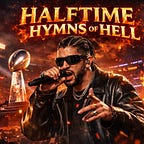


“The most dangerous seduction is the one that feels safe because you never translated the words!” — Wendell Hutchins II
The Gospel According to Halftime
There is a reason the enemy has never abandoned the stage.
He does not need a pulpit when he can purchase a platform; he does not need a choir when he can hire a crowd; he does not need to persuade the mind when he can saturate the body in rhythm, and teach the soul to applaud before it understands what it has approved.
Without flattery and without fog, let this be said plainly: the NFL halftime show is not an intermission. It is a liturgy. It is America’s shared ceremony of desire, performed at the precise moment when attention is highest, defenses are lowest, and the whole nation, for a few minutes, becomes one congregation.
And this is why discernment must be fiercest right there, in the bright center of the spectacle, where lights drown out conscience and volume substitutes for virtue.
Because the halftime show not only entertains, it initiates.
It catechizes the imagination. It trains the reflexes of the heart. It teaches a generation what to celebrate, what to excuse, what to call freedom, and what to call normal.
Now let me report what that looks like, not as a partisan reaction, but as a moral reality unfolding in plain sight, the way Heaven sees it.
The Field Report
It begins the way most seductions begin, not with a warning, but with warmth.
A father reaches for the remote because it is “the big game,” the communal holiday of the American calendar. A mother finishes the food; children sprawl across the living room; neighbors laugh; phones glow; the room feels safe, familiar, even wholesome. Nobody is thinking about the condition of the soul, because that is what comfort does: it persuades us that we are not in danger.
Somewhere else, under a roof of steel and floodlights, a stadium fills like a cathedral. Thousands rise, not to pray, but to chant. They lift hands, not in surrender to God, but in surrender to atmosphere. The air itself is engineered, sound layered upon sound, light pulsing like a heartbeat, the crowd becoming a single organism, breathing together, roaring together, responding on cue.
Then the field changes.
The contest pauses, and the ritual begins.
And our nation calls it halftime, as if it were a break. But Heaven does not call it a break. Heaven calls it a moment of formation, a public shaping of desire, a mass rehearsal of what the heart will tolerate, celebrate, and eventually normalize.
This is where the subtle work is done, not always in the obvious extremes, not always in the crude props. The enemy is wiser than crude. He is older than vulgarity. He has been seducing humanity since Eden, and he has perfected the art of making poison look like perfume.
So the strategy is not always to shock; it is to soften. It’s not set to scandalize, but to anesthetize.
To persuade the everyday “ticketholder,” the casual attendee, the man who is not trying to be evil, and the woman who is not chasing darkness, that because it looks less offensive, it must be less harmful. Because the edges are smoother, the substance must be cleaner. Because it does not trip the alarm in the first five seconds, it must be safe enough to cheer.
But this is not how the soul is protected. Because the soul is not formed only by what it understands, it is formed by what it repeatedly welcomes.
And here is the danger that hides in plain sight: sometimes the seduction is not in what is displayed, but in what is untranslated. The room is full of sound, the stadium is full of motion, the body is fully engaged, the emotions are fully recruited, while the mind has not weighed the meaning of what is being praised.
So the crowd does what crowds do.
It moves. It cheers. It dances.
And many do it without comprehension of the words that are shaping the moment.
That is not a neutral circumstance. That is spiritual vulnerability.
Because when the body celebrates while the mind is absent from the meaning, the conscience is bypassed. The feet are saying yes while discernment is still trying to catch up. The hands are raised while the heart has not examined the agreement. And the enemy does not need understanding to begin formation. He only needs repetition, atmosphere, and applause.
Ignorance does not disinfect the message. It only disables resistance.
That is Babel reborn, not in stone and mortar, but in bass and light, where language becomes a veil, and the veil becomes permission, and permission becomes practice.
There is a peculiar mercy in understanding what is being said. When the words are plain, the conscience can object. When the words are foreign, the body keeps moving while the soul never gets a vote. This is why the moment a stadium can dance while not understanding, because rhythm becomes anesthesia, permitting the body to celebrate what the mind would have rejected, because conscience never heard the words.
The Narcotic of “Not That Bad!”
There it is. The sentence that sounds harmless, but behaves like a drug: “It’s not that bad.”
It is spoken with a shrug, with a half smile, with the relief of a conscience that wanted permission more than it wanted purity. It is the phrase people use when they do not want to wrestle with what they just welcomed. It is not a conclusion drawn from careful, deliberate weighing; it is a sedation administered to the soul, because the soul, like the body, has pain receptors for a reason. They are not there to torment you; they are there to warn you.
So when a nation learns to numb its warnings, it does not become freer; it becomes less alive.
This is one of the most observable realities of moral formation; it rarely collapses by a dramatic fall; it erodes by gradual permission. The human heart does not usually leap into corruption; it drifts into it, one lowered eyebrow at a time, one softened standard at a time, one laugh at what used to grieve at a time.
And here is why the phrase is so dangerous.
“Not that bad” is not a category in Heaven’s court.
Heaven does not measure a thing by comparing it to worse things; Heaven measures a thing by comparing it to light. Scripture does not ask whether a song is cleaner than another song; it asks whether it is clean. It does not ask whether a show is less graphic than last year; it asks whether it is edifying, whether it is pure, whether it is true.
You see, comparison is how the conscience negotiates, but holiness is how the conscience is trained.
And once comparison becomes the instrument, the downward slope becomes respectable, because you can always find something worse to make your current compromise look like wisdom.
That is not discernment, that is self-soothing.
We can watch the mechanism at work as plainly as we watch smoke rise from a fire.
The crowd celebrates without understanding, and because the celebration felt communal and safe, the heart begins to label the moment as harmless. The body enjoyed it. The room laughed. The children were quiet. The party continued. Nothing exploded. No lightning fell. And because judgment did not strike in the moment, the soul whispers, “See, you were overreacting.”
But the absence of immediate consequences is not proof of innocence; it is often the mercy of God giving us time for recognition and repentance.
This is why Scripture warns us so clearly about gradual hardening. Hebrews speaks of hearts becoming hardened, not in a single instant, but through repeated exposure to what should have been resisted. Conscience can be trained, and conscience can be dulled. What once startled you can become background noise. What once made you turn your head can become the soundtrack of your day.
And the enemy understands this better than most people do. He does not need to bring the whole house down in one night; he only needs to rearrange what feels normal.
Because normal is powerful. Normal is what you stop questioning. Normal is what you stop guarding against. Normal is what you stop praying about. Normal is what you start defending. That is the path from attendance to agreement.
Then something else happens, and it’s almost always overlooked because it looks so small.
The show ends, the game resumes, the night moves on. But the hook remains. A line repeats in the mind because rhythm is designed to lodge. The melody follows you into the kitchen. Somebody hums it while cleaning. Somebody jokes about a lyric they did not understand, but liked the way it sounded. A child repeats a phrase they heard phonetically, not knowing what it means, because children learn by imitation, and they have no grid for weighing what adults should have weighed.
That moment does not feel spiritual, but it is. Because what you repeat, you rehearse. And what you rehearse, you reinforce. And what you reinforce, you make room for.
The Bible calls this the sowing of seed. It is not always dramatic; it is often quiet. Mark says, “Take heed what ye hear.” Not only because what you hear informs you, but because what you hear enters you. It becomes material for thought, fuel for imagination, and imagination is the workshop where desire is shaped.
So the danger is not only what is seen, it is what is planted.
In my observation, a great many people do not intend to approve depravity. They are not trying to be wicked. They are not plotting rebellion. They are tired, they are busy, they are trying to enjoy a night of relaxation, celebrating a national pastime. That is exactly why this strategy works so well. It does not depend on hostility; it depends on passivity. It does not require hatred of God; it requires inattentiveness to the gates.
And the gates are real.
Scripture speaks of eyes that must be guarded, “I will set no wicked thing before mine eyes.” It speaks of thoughts that must be taken captive, because thoughts, left untended, do not remain neutral, they gather momentum. It speaks of the need to “prove all things,” to test what is presented, to hold fast to what is good.
That is not fragile religion; that is spiritual maturity.
Hebrews calls it having senses exercised to discern both good and evil. That language is not poetic; it is anatomical. Discernment is a muscle. Muscles either strengthen through use or weaken through neglect. When you repeatedly celebrate without understanding, you are not training discernment; you are training surrender. You are practicing applause without examination, and then you are surprised when examination becomes difficult.
This is the moment when Babel in bass and light becomes more than an image.
Because Babel is not only about language, it is about unity without submission to God. It is about a civilization gathered around a shared project, reaching upward on its own terms, crowned with its own glory, and then clothed in confusion so that the project cannot accelerate.
In the modern inversion, the confusion becomes part of the acceleration.
Not confusion of sound, but confusion of meaning.
The rhythm unifies. The spectacle unifies. The chant unifies. The emotion unifies. And meaning, the moral content, is left untranslated, which means the conscience is left unengaged, which means the unity proceeds without the interruption of truth.
So you have a crowd that is unified, not by the clarity of what is being celebrated, but by the feeling of celebration itself.
That is not harmless unity. That is unity that can be directed. You see, the “ticketgoer” leaves the moment with a new internal rule they never announced out loud, but they did adopt.
If it is wrapped in beauty, it must be safe.
If it is in another language, it must be less dangerous.
If it did not shock me immediately, it must not be harmful.
If the crowd cheered, it must be acceptable.
These are not just cultural assumptions; they are spiritual vulnerabilities because they teach the heart to outsource discernment to atmosphere, and atmosphere is easy to engineer.
So what is the corrective? Not panic. Not paranoia.
Sight.
A return to translation. A return to tested intake.
A return to the holy discipline of asking, before I celebrate this, what am I agreeing with, what am I rehearsing, what am I feeding, what am I planting in myself, and what am I authorizing in the hearing of my children.
Because the truth is simple, and it is sobering. If the message would trouble you in your own language, it does not become clean because it arrived in a different tongue.
Poison does not stop being poison because the cup is gold. And the serpent does not stop being a serpent because he sings.
The Priesthood of the Home
There is a mistake people make, and they make it with a smile. They imagine that formation only happens in formal places, in classrooms, in churches, in courts, in policies, and platforms. But God, who designed humanity, locates the primary battleground somewhere far more ordinary and far more decisive.
The home.
Not because the home is glamorous, but because the home is government. It’s the primary level of governance. Not because the home is loud, but because the home is forming. The home is the first cathedral a child ever enters, the first nation a soul ever learns to live inside, the first set of laws a heart ever absorbs.
And that is why the Bible does not begin its instruction for society with kings, it begins with fathers and mothers.
Hear the ancient architecture of spiritual responsibility, not as a sermon, but as reality.
In Deuteronomy 6, God places His words in the center of the household. He speaks of commands being held in the heart, taught diligently to children, spoken of when you sit in the house, when you walk by the way, when you lie down, when you rise up. In other words, the ordinary rhythms are the altar. The daily flow is the classroom. The home is not a neutral space; it is a shaping space.
And if God established the home as the primary environment where truth is repeated, then we must also acknowledge that if truth is not repeated there, something else will be.
If the Scripture is not shaping the imagination, something else will.
If the songs of Zion are not in the air, the songs of Babylon will be. Not because Babylon is so strong, but because empty air never remains empty.
This is what makes Sunday evening’s halftime show, and all spectacles like it, so spiritually effective. They do not have to break into your house; they only have to be welcomed.
And the welcoming rarely feels like a moral decision. It feels like “just a moment,” “just a song,” “just a show,” “just a break,” “just entertainment.”
But Heaven does not measure “just” the way modern speech does. Heaven weighs influence. Heaven weighs repetition. Heaven weighs what is allowed to have continual access to the gates.
Because the gates are real.
The eye is a gate.
The ear is a gate.
The imagination is a gate.
And the heart is a city.
A city without gates is not compassionate; it is vulnerable. A city that never watches its entrances is not open-minded; it is undefended. The Scripture does not call that maturity, it calls that foolishness.
So the question is not, do you have gates? The question is, who governs them?
Because in every home, someone is governing the gates, either by intention or by abdication. Either by discernment or by default. Either by a father’s watchfulness and a mother’s wisdom, or by the crowd, the algorithm, the stadium, the playlist, the screen.
If nobody translates, the culture interprets.
If nobody shepherds, the spectacle catechizes.
If nobody guards, appetite rules.
And that is not a theory. It is simply what happens when authority is left vacant. Something will always sit in the empty chair.
This is why Scripture speaks with such sobriety about what a house permits.
Not because God is trying to make joy impossible, but because He knows joy has enemies, and those enemies do not always come with horns. Sometimes they come with hooks, with choruses, with charisma, with the sheen of popularity, with the disarming language of, “Everybody’s watching it.”
Now bring this down into the real room where the game is on. Plates on the coffee table. Children within earshot. A living room full of good people, not plotting evil, simply relaxing, simply enjoying a communal night.
And then the halftime liturgy enters. Sound saturates the room. A mood is established.
Bodies begin to move, maybe only slightly, a tap of the foot, a hum, a smile, because rhythm is persuasive and community lowers defenses. And while the room’s attention is captured, something more subtle is also happening.
The gate is being opened.
Not necessarily to explicit images, not necessarily to obvious props, but to the permission structure behind the message. To the mood of it. To the posture of it. To the spirit of it, the spirit that teaches appetites to laugh, to desire, to trivialize, to normalize.
And when the words are untranslated, the danger becomes cleaner, not because it is less corrupt, but because it is less resisted. The conscience cannot object to what the mind has not evaluated. So the body celebrates first, and the moral discernment arrives late, if it arrives at all.
This is why the priesthood of the home must include translation.
Not translation in an academic sense, but translation in a parental, shepherding sense.
What is being said?
What is being celebrated?
What is being sold as normal?
What is being smuggled under the cover of beauty?
What is being planted in the mind through repetition?
Because the home is always teaching, even when it is silent, remember this: silence is not neutrality; silence is curriculum.
A father who never speaks about what his children are consuming is still teaching. He is teaching that it is not worth examining. A mother who never challenges what enters through screens is still forming an environment. She is forming an environment where the loudest voice wins.
And the loudest voice in modern life is rarely truth; it is usually entertainment.
So what does priesthood look like in real terms? It looks like this.
A man does not merely provide money and safety; he provides meaning. He interprets. He names things. He draws lines. He makes distinctions. He is not harsh, but he is clear. He is not fearful, but he is awake. He understands that love without leadership becomes vulnerability, and leadership without love becomes tyranny, and God calls him to neither vulnerability nor tyranny, but to governing tenderness.
A mother does not merely create comfort; she creates culture. She curates atmosphere. She feels what is entering the room, and she knows when something is trying to recruit the imagination away from innocence, away from purity, away from reverence.
And together, the household becomes what God intended, a sanctuary of formation, not a passive theater of consumption.
This is why the ancient text says to teach diligently, not occasionally. Diligence is not a mood; it is a practice. It is the quiet insistence that in this house, we do not applaud what we cannot affirm. In this house, we do not laugh at what dishonors God. In this house, we do not surrender our gates to whatever the crowd calls normal.
And if someone says, “That’s extreme,” then let reality answer.
Extreme is not guarding a child’s imagination. Extreme is not refusing depravity. Extreme is not translating lyrics before you allow them to become the soundtrack of your home. Extreme is the modern assumption that you can pour anything into the gates and remain unchanged. Extreme is believing the heart is a landfill that can receive any waste without consequence.
But the heart is not a landfill. The heart is a garden, and gardens do not grow by accident.
They grow by what is planted and what is pulled; by what is watered and what is removed; by what is welcomed and what is refused.
So the priesthood of the home is not a quaint religious idea. It is the most practical survival strategy in a seductive age. It is the refusal to let the crowd disciple your children. It is the refusal to let the stadium become your sanctuary. It is the refusal to let “not that bad” become the moral standard in your living room.
The Lord God did not give you a house only to shelter your body; He gave you a house to shape your soul. And the enemy loves nothing more than a household that has stopped watching the gates, because then he can walk through smiling, singing, and applauding. Friends, in an era when Babel sings through bass and light, the first line of defense is fathers and mothers in the home, a Shepherd inside the heart, and a Watchman at the gate.
Let the matter be settled!
So let the matter be settled, not as an argument, but as an accounting.
The stadium will keep preaching, because the culture never stops catechizing. The crowd will keep clapping, because the masses are trained to confuse volume for virtue. The screen will keep shining, because spectacle is profitable. But the Lord did not set the watchman on the fifty-yard line; He set the watchman at the gates of the home.
The home is where appetites are trained, where standards are set, where the gates are either guarded or surrendered. And every household will be shaped, either by intentional priesthood or by accidental permission. There is no third way. If the father will not interpret, the algorithm will. If the mother will not nurture, the culture will. If no one governs the gates, the serpent will never need to break in; he will be invited.
So in this hour, the call is not to panic, but to a revival of godly government in the home. It’s a call to quiet authority.
To the courage to translate before you celebrate, to weigh before you applaud, to test before you welcome. To say, without theatrics and without apology, not in this house, not in our agreement, not in our children, not in our atmosphere.
Because the most dangerous seduction is the one that feels safe, not because it is pure, but because it is untranslated.
And if the enemy can teach a nation to dance before it understands, he can teach a nation to surrender before it discerns.
But if a home will stand in its God-ordained priesthood, the spell breaks. The crowd loses its power. The stadium becomes what it truly is, a place of entertainment, not a place of formation. The conscience wakes up. The gates are guarded. The imagination is reclaimed.
For the serpent does not stop being a serpent because he sings in a beautiful tongue, and poison does not stop being poison because the cup is gold.
So watch the gate. Guard the house. Translate the song. And let your home become again what God intended, a sanctuary of clean joy and holy strength, where worship has understanding, and celebration never requires the conscience to fall asleep.
** Before you doubt my concerns or dismiss my position, go translate the lyrics to the songs Bad Bunny performed at Halftime, and then after they pick you up off the floor, write me your concerns with this article. — Wendell Hutchins


