

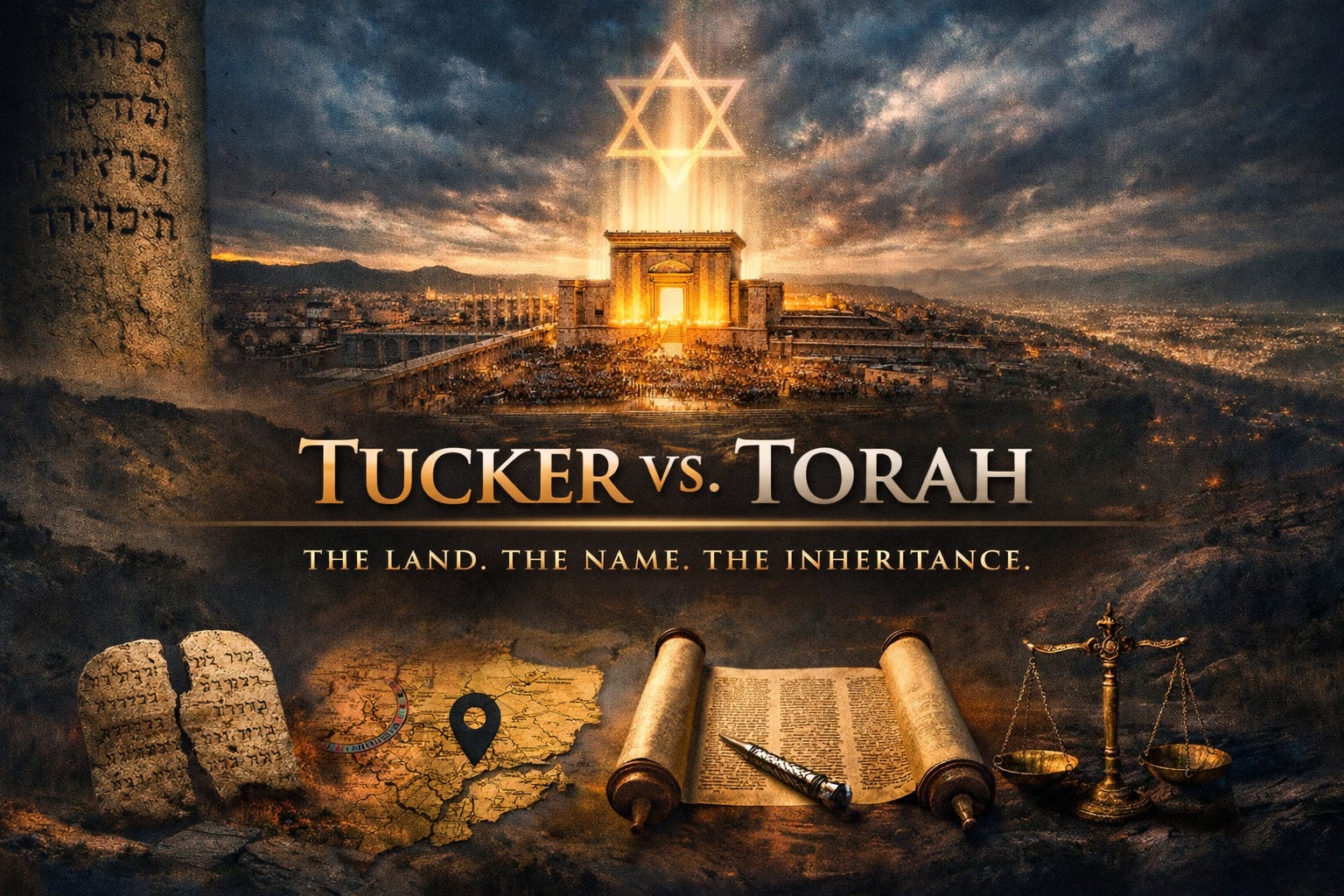
A Torah Rebuttal to Tucker Carlson’s Frame, and to the Anti-Israel Drift it Feeds
Some interviews are conversations, and others become corridors, corridors through which thousands of listeners walk into a new posture without realizing they have crossed a threshold.
Tucker Carlson sat with Ambassador Mike Huckabee and turned the lens toward the ancient text. He raised Genesis 15, he spoke of boundaries, he asked what it means “today,” and then the moment arrived when a sentence became a headline.
“It would be fine if they took it all,” the ambassador replied, a line now echoing across capitals and newsrooms, condemned as dangerous, inflammatory, provocative. Later coverage noted efforts to frame the remarks as taken out of context, even as the uproar continued.
But beneath the media firestorm is the deeper matter, the matter of Torah itself, because the interview exposed the two distortions that keep breeding confusion:
First, the distortion that attempts to invalidate covenant heirship, challenging the continuity of the sons of Abraham, Isaac, and Jacob as the lawful heirs named in Torah, so that Israel’s claim can be rejected at the level of covenant identity before any moral or political question is even debated.
Second, the distortion that shouts, “Take it all,” as though promise means conquest and Covenant means empire, forgetting that Torah draws borders, casts lots, assigns inheritances, protects neighbors, and disciplines kings, because the God who gives land also governs the people who live on it.
So let this be with covenant grammar, with inheritance law, and with Torah’s own legal architecture.
Because Torah does not float. Torah maps.
Covenant is not a Mood; it is a Legal Bond.
The Abrahamic Covenant is promissory; it establishes the heir line and ties it to land and blessing. The Mosaic covenant is governmental; it disciplines those people who carry the promise.
Here is the continuum of Covenant in bond: A legal reality —> sealed by oath —> carried through blood —> and remembered by God.
Promise tells you who. Torah tells you how.
Promise identifies heirs. Torah governs heirs.
There is a subtle deceit that keeps slipping into modern conversation like Carlson’s, even among people who love the Scripture. We start talking about Covenant as if Covenant were a feeling or a “spiritual vibe,” a poetic way of saying God is generally favorable toward somebody somewhere.
The thing we must always be cognizant of is that the Covenant is a bond. Covenant is architecture. Covenant is law and love braided together, not love as sentiment, but love as holy fidelity. In Scripture, Covenant is not the sparkle of a moment; it is the binding of a relationship in public, under oath, with terms, with witnesses, with signs, with consequences.
That is why the Bible uses the word בְּרִית (berit). A covenant is a binding arrangement, a pledged relationship, a bond that can be kept or violated, honored or profaned. And when the text says, “they cut a covenant,” it is not a metaphor. The phrase is כָּרַת בְּרִית (karat berit), “to cut a covenant,” because Covenant in Scripture is often ratified through blood and enacted through a solemn ritual act that declares, “This is not a casual agreement. This is life and death loyalty.”
You cannot do serious Bible theology without seeing this: Covenant is the language God chose to turn promise into history.
The following are a few textual references used to learn what the Covenant is and how God feels about it. Covenant is the language God chose to turn promise into history.
Genesis 12:1–3, 7
Genesis 15:1–21
Genesis 17:7–8
Genesis 22:15–18
Exodus 19:3–8
Exodus 24:3–8
Leviticus 26
Deuteronomy 28
Deuteronomy 30:1–10
Leviticus 26:42–45
The Abrahamic Covenant: Promise That Creates the Heir-Line
Israel is YHWH’s portion, His consecrated share among the nations. The following Scripture gives us pivotal insight:
“The LORD’s portion is His people, Jacob His allotted inheritance.” — Deuteronomy 32:9
That is not a slogan. That is not speculation. That is not “test the genome.” That is not sentiment; it is ownership language. It is a sworn divine pledge. It is consecration language. Among the nations, God claims a portion for Himself.
The Bible’s word for seed, זֶרַע (zeraʿ), is not only a biological term; it functions as a covenant term. It can point to descendants, yes, but it also points to a covenant line; a continuity of identity formed by God’s call, God’s promise, God’s oath.
And notice how Genesis intensifies the certainty of that Covenant: God does not only promise, God swears. The text uses oath language, the kind of language that turns promise into sworn certainty. In Genesis 22, God says in essence, “By Myself I have sworn.” That is a terrifying line, because it means the guarantee of the Covenant does not rest on Abraham’s strength, but on God’s faithfulness.
This is why those who try to dissolve the sons of Abraham, Isaac, and Jacob into a fog of “we can’t really know” are not doing Torah thinking. They are doing modern skepticism, then forcing Torah to bow.
Friends, the Abrahamic Covenant is a divine pledge that creates a people and binds that people to a promised inheritance.
And the Torah pattern is consistent. In Eden, holiness drew a boundary around what must not be seized. In Israel, holiness draws a boundary around what is sacred to God. The tithe belongs to YHWH; it is holy to YHWH. God reserves what is holy, not because He lacks, but because He reigns.
Scripture for consideration: Deuteronomy 32:9, Exodus 19:5–6, Genesis 2:16–17, Leviticus 27:30, and Psalm 135:4
If someone wants to speak about Israel as though it were just another nation with a negotiable identity, the Scripture correctly instructs them. Israel is not only a nation among nations; Israel is YHWH’s claimed portion within the nations.
The Mosaic Covenant: Governance for Life on Holy Ground
Not cancellation of promise, but discipline of the promised people. This is an area that is so often misunderstood: Sinai. The Mosaic covenant does not exist to replace Abraham; it exists to shape Abraham’s seed into a holy nation capable of living within a holy inheritance.
At Sinai, God does something that modern ears struggle to hear: He binds a redeemed people to a covenant charter. Torah becomes the constitution. And yes, the Covenant includes conditional language, “if you obey,” not because God is fickle, but because life on holy ground is not morally neutral.
This is why the Mosaic covenant is filled with חֻקִּים (chukkim) and מִשְׁפָּטִים (mishpatim). Statutes and Judgments. Why? Because covenant governance is the shaping of a nation’s reflexes: worship, justice, mercy, purity, economics, speech, sexuality, and the treatment of the vulnerable.
In Exodus 24, the Covenant is ratified publicly. There is a book, a hearing, a response, and there is blood. The people say, “All that the LORD has spoken we will do,” and then Moses declares, “Behold the blood of the covenant.” That is not a metaphor; that is Covenant in the bloodstream of a nation.
The Abrahamic Covenant identifies the heirs, while the Mosaic Covenant governs them.
Some key Scriptural insights are:
Exodus 19:3–8 (covenant frame; “if you obey…”);
Exodus 20:1–17 (the Ten Words; covenant charter core);
Exodus 24:3–8 (Book of the Covenant; blood ratification);
Leviticus 26 (sanctions; discipline; restoration logic embedded);
Deuteronomy 28 (blessings and curses; covenant administration)
Title vs Tenancy: Torah Holds Both Without Contradiction
Promise can remain while occupancy is disciplined.
This is where so many public voices stumble. They treat exile as if exile equals erasure, as if discipline equals cancellation, or as if judgment means God never pledged anything at all.
But the Scriptures refuse that simplification. Torah teaches that the land is morally reactive: it can “vomit out” defilement. That is covenant governance. It is the reality that a people can be expelled from holy ground because they have turned holy ground into a stage for abominations.
And yet, the Scriptures also teach that God can discipline without forgetting, judge without abandoning, and exile without nullifying His oath to the fathers. This is the covenant tension that shallow commentators cannot hold: judgment is real, and covenant remembrance is real.
When Leviticus says God “remembers” His Covenant, the Hebrew is not a mental note. It is covenant action language: God’s fidelity to His pledged bond.
This is why Deuteronomy can speak of return after scattering. And it does not speak of return as human triumphalism; it speaks of return as covenant mercy; of God restoring, God gathering, and God circumcising the heart.
So when someone says, “Israel sinned, therefore Israel is no longer Israel,” The Bible rebukes that logic. Covenant discipline is not covenant deletion.
Why This Matters!
Because Tucker Carlson’s frame, and the broader anti-Israel drift that feeds upon it, often tries to win the argument before it begins by dissolving the category of covenant heirship. If one can make the sons of Abraham a fog, you can make the land “ownerless,” and then you can declare the entire biblical tether void without ever having to wrestle with Numbers, Joshua, inheritance law, or “the place where God puts His Name.”
Covenant is not mood, Covenant is bond, Covenant is oath, Covenant is blood,
Covenant is governance, and Covenant is remembrance.
I have found more often than not that anyone who speaks about Israel without covenant categories is not doing biblical analysis; they are doing cultural commentary with Bible words pasted around the periphery.
“He Will Place His Name There”: the Name-Place Covenant Geography becomes a worship government, and the public center of allegiance.
There is a phrase in Deuteronomy that you cannot treat as decorative without losing the plot of Torah: “the place that the LORD your God will choose… to put His Name there.” This is not religious branding, nor is it a poetic flourish. It is covenant architecture. It is heaven’s way of saying, “I will tether worship, identity, and obedience to a chosen center, so My people do not dissolve into a thousand altars and a thousand gods.”
Covenant not only creates a people, but it also orders a people. And in Deuteronomy, one of the great ordering acts is this: YHWH chooses a place, and He attaches His Name to that place.
Hebrew lens: what “Name” means in Torah
The word is שֵׁם (shem): “name.” But in covenant language, shem carries weight beyond a label. In Scripture, “Name” means identity, authority, claim, reputation, and covenant ownership. When God puts His Name somewhere, He is not reducing Himself to geography. He is marking geography as the authorized theater of covenant worship.
Deuteronomy uses two related phrases and both are extremely important:
לָשׂוּם אֶת־שְׁמוֹ שָׁם (lasum et-shemo sham): “to put His Name there”
לְשַׁכֵּן שְׁמוֹ שָׁם (leshakken shemo sham): “to cause His Name to dwell there”
Do you notice the restraint and the brilliance? Torah often speaks of God’s Name dwelling, not God’s essence being confined. The Bible can say, without contradiction, “the heaven and highest heaven cannot contain You” while also saying His Name is set in a place. The point is not confinement; the point is covenantal localization of worship and allegiance.
We see this in:
Deuteronomy 12:5–7, 11: the place YHWH chooses “to put His Name there”; worship centralized
Deuteronomy 14:23–25: tithe brought to the Name-place to learn holy fear; provision for distance
Deuteronomy 16:1–17: the pilgrimage feasts drawn toward the chosen place
2 Chronicles 6:20; 1 Kings 8: temple prayer tied to the “Name” logic; heaven cannot contain God, yet His Name is honored there
Jeremiah 7:1–14: the prophetic warning: the house “called by My Name” is not a magic shield if His covenant is violated.
The Name-Place is God’s cure for Israel’s greatest danger: syncretism
Deuteronomy is fighting a war on two fronts: 1) idolatry that corrupts worship, and
2) fragmentation that corrupts the nation’s moral reflexes.
If every tribe, every family, every ambitious leader can raise an altar wherever they feel spiritual, Israel becomes spiritually ungovernable. So Deuteronomy says: Bring your worship to the place I choose. Put your sacrifices, vows, feasts, and tithes under My Name, under My oversight, under My Covenant. This is worship as government.
That’s why Deuteronomy repeatedly uses verbs of seeking and coming:
דָּרַשׁ (darash) — to seek, inquire, pursue
Israel is commanded to seek that place and come there, not to invent worship on the fly.
Centralization is not control for control’s sake. It is a mercy. It is a guardrail. It is God preventing Israel from turning the holy into a marketplace of competing gods.
Additional textual considerations:
Deuteronomy 12:4–5: “You shall not worship as they do… but you shall seek the place…”
Deuteronomy 12:8–9: “You shall not do as we are doing here today, everyone doing what is right in his own eyes…”
Deuteronomy 13: covenant loyalty; refusal of seducing voices to other gods.
3. The Name-Place gathers the whole nation into one covenant rhythm.
“Israel as YHWH’s portion” is geographic because Israel is God’s portion among the nations. In fact, Deuteronomy commands that the tithe be brought there, not simply as an economic mechanism, but as discipleship: “that you may learn to fear the LORD your God always.” I see something here: the tithe in Deuteronomy is not just for funding God’s kingdom; it is for the formation of God’s kingdom; a nation trained at the Name-place.
And, we see the pilgrimage feasts doing the same work: the calendar becomes covenant catechesis. The people repeatedly travel toward the Name, so the story stays alive in their bones.
Consider the following texts:
Deuteronomy 14:23: tithe at the chosen place “that you may learn to fear the LORD”
Deuteronomy 16:2, 6, 11, 15–16: feasts “at the place the LORD chooses”
Deuteronomy 26:1–11: firstfruits confession: the worshipper recites the redemption story at the place of offering
4. The Name is Covenant Claim: what God names, He claims!
There is an older Torah echo that makes this even sharper. In the priestly blessing, God says, “So shall they put My Name upon the people of Israel.” That is God marking. That is God designating ownership with blessings intertwined. God claims a people by His Name.
Watch this: if God can place His Name upon a people, then Deuteronomy’s logic is consistent: God also places His Name in a place so the people’s worship does not lose its center.
So, we see:
Israel is YHWH’s portion, His consecrated people.
The land becomes the theater where His Name is publicly declared and His glory honored.
The Name-Place becomes a spiritual axis, drawing loyalty, shaping ethics, disciplining worship.
Numbers 6:27: “They shall put My Name upon the people of Israel…”
Deuteronomy 12:5: “to put His Name there”
2 Chronicles 6:20: temple as “Name” focal point
If the place is “called by His Name,” then the nation cannot hide behind it. The prophets refuse that perversion. Jeremiah stands at the gate and warns: Do not treat the Name-place as a magic shield while you violate covenant justice. The Name does not excuse sin; the Name exposes sin.
That means the biblical argument for Israel’s covenant tether to land and place is a summons to holiness, not an excuse for licentiousness. God attaches His Name, and therefore His reputation, to the people and the place.
Consider:
Jeremiah 7:4–14: the house “called by My Name” and the warning against false trust
Deuteronomy 16:18–20: justice in the land.
Deuteronomy 17:14–20: kings restrained by Torah (power disciplined under covenant)
Why Is This Spiritual Contest Cosmic In Nature
In Scripture, the battle is often a battle over worship: who will be honored, who will be named, and who will be obeyed. If God places His Name somewhere in history, that “place” becomes a flashpoint of cosmic contest for conquest and allegiance.
So yes, empires rise and rage. Yes, accusations multiply. Yes, propaganda swells. Because if Satan can sever the people from the Name-place, or make the Name-place meaningless, he does not win a land argument; he destroys the covenant lineage of a Redeemer and His redemption story.
And that is why the attempt to declare Israel “un-tethered” is not a neutral exercise. It is an effort to make the covenant story collapse at the level of identity and worship before the conversation even begins.
For further study, see:
Genesis 3:15: seed-conflict pattern introduced at the beginning
1 Peter 5:8: spiritual predation language
Revelation 12:17: warfare imagery against covenant-keeping offspring
So, the phrase “He will place His Name there” means the land is not treated as disposable real estate in Scripture. It means the land has become covenant geography. It means worship is governed. It means the nation is gathered. It means the tithe trains the heart. It means the calendar becomes catechesis. It means kings are restrained. It means prophets can call the people to account. It means holiness has a center.
And if you sever the sons of Abraham, Isaac, and Jacob from that covenant architecture, you are not “asking questions.” You are dismantling the very grammar of Torah.
Promise Becomes Property —
Torah writes the inheritance algorithm, Joshua executes it in public, and Covenant becomes cartography.
It is not enough to say, “God promised the land.” Many people can say that and still miss Torah entirely. Torah does not stop at promise. Torah proceeds to procedure. It turns Covenant into a public inheritance system, with numbers, borders, lots, witnesses, and named administrators.
This is where the genealogical erasure collapses. Because the claim that “Israel has no right” often hides inside the fog of: “We cannot really know who the heirs are.” Scripture answers with the opposite posture. Specifically, Torah names the heirs by covenant identity, then distributes inheritance through a lawful process so that the nation can live without tribal chaos and without perpetual dispute.
In other words, Torah anticipates the modern argument and preempts it with covenant administration. We see this premise in Numbers 26:52–56, Numbers 33:54, Numbers 34, Joshua 14:1–5, Joshua 18:1–10, and Joshua 19:51.
There are seven important points to be made here:
The heirs are not an abstraction; the Scripture counts them.
The Book of Numbers is the infrastructure of inheritance. Before Israel sets foot into the land, God orders a census. Why? Because inheritance in Scripture is built on named family units, tribal identity, clans, and households. This is why the text speaks in the language of fathers’ houses. Then the land is said to be given as נַחֲלָה (nachalah), inheritance. Not a temporary campsite, nor a vague spiritual metaphor; inheritance. The Book of Numbers does something extremely important here. It ties inheritance to the nation’s covenant structure and assigns proportion by population, so the system is both lawful and equitable. See Numbers 26:52-56 concerning inheritance, proportion, and lots.
The mechanism is public and sacred: inheritance “by lot.”
Then the Scripture commands something that modern readers often misunderstand.
The land is to be distributed by lot, גּוֹרָל (goral). This was done to ensure covenant impartiality. The lot functions as a sanctified public mechanism that prevents tribes from charging the leadership with favoritism and prevents powerful clans from taking what is not theirs.
It says, in effect, “This inheritance is not to be seized; it is to be received.”
The lot puts the distribution under heaven’s oversight, not man’s manipulation. That is why the Scriptural language repeats that the division is done “before YHWH.” The land is not handed out by private deals; it is administered as a covenant trust. See Numbers 26:55–56, Numbers 33:54, and Joshua 18:10.
Torah disciplines the conversation with borders.
Genesis contains grand promise language that many people quote. But Scripture also contains measured boundary language that many people ignore. Numbers 34 draws the contours of the inheritance land because covenant inheritance is not a blank check; it is a defined trust.
So, when someone tries to weaponize “from the river to the river” language into modern policy absolutes, the Bible replies, “Let us speak with the full counsel of Scripture, including borders, allotments, and the moral governance of kings.”
See Numbers 34, Deuteronomy 16:18–20, Deuteronomy 17:14–20.
Joshua executes the Torah plan, rejecting any notion of improvisation to ensure continuity.
When Israel crosses the Jordan, Joshua is not inventing a national land policy. He is finishing what God had already outlined.
The Scripture names the administrators, and that matters. The inheritance is apportioned under:
Joshua, the covenant leader in Moses’ succession,
Eleazar, the high priest, the worship government in flesh and blood,
The heads of the fathers’ houses, tribal leadership in public view.
This is the perfect portrait of covenant administration. This is Israel receiving inheritance under lawful order. Read more about this in Joshua 14:1–5 (Eleazar, Joshua, tribal heads), and Joshua 19:51 (a summary of allotment).
Shiloh is the courtroom: the lots are cast “before YHWH.”
Shiloh becomes the stage where the Covenant becomes the map.
The Tabernacle is set up there. The national worship center is established. Then, in that environment of holiness “before YHWH,” Joshua casts lots and assigns portions.
Do you hear the theology in this act of sacred government? Inheritance is not separated from worship. Land distribution is not separated from holy presence. You cannot detach Israel’s geography from Israel’s liturgy without tearing the Scripture in half. For further study, I encourage you to examine Joshua 18:1-10 and Joshua 19:51.
The structure is complete here, and yet, this is another place where careless voices get clipped.
The Tribe of Levi does not receive a tribal tract; that is true, and Scripture tells us why. But Joseph is doubled through Ephraim and Manasseh, so the allotment structure remains whole.
This is not a mistake; this is covenantal design. It keeps the inheritance system coherent while preserving priestly distribution through the land.
The theological verdict is in.
Anyone who wants to claim Israel has no right to the land must do more than object to modern politics. They must erase God’s inheritance architecture written in Torah. They must undo the Book of Numbers’ allotment and allocation distribution system
. They must silence Joshua’s public distribution at Shiloh. They must flatten Covenant into a fog and call that fog “nuance.”
But God’s word is not opaque; it is not a truth hidden in pavilions of mystery or closeted in shadows. God’s Word counts inheritance. God’s Word names heirs. God’s Word provides boundaries for land and sacred lots for clans. God’s Word is public administration, and the Torah is God’s Covenant becoming cartography. For additional research, study Numbers 26:52–56;
Numbers 33:54; Joshua 18:10, and Joshua 19:51.
Levi, the Tithe, and the Distributed Priesthood
This is perhaps one of Scripture’s most misunderstood sentences and, simultaneously, one of its most revealing designs.
The Tribe of Levi receives no tribal tract. That line is often repeated as if it means Levi was “excluded.” But the Scripture does not present Levi as neglected. The Scripture presents Levi as distributed, and this is the difference between landlessness as deprivation and landlessness as vocation.
Levi is not landless, as in homeless. Levi is landless, as in non-territorial, because the priesthood is not meant to be confined to one corner of the map. The priesthood is meant to be woven through the whole nation, so that covenant life becomes a national way of being. Levi was to be represented in every Tribe, and every Tribe was to participate in the tithe of the land. This is a beautiful portrait of Levi represented throughout Israel, planted like sacred sentinels across the tribes, not as conquerors and stewards of acreage, but as custodians of memory, teachers of Torah, and living reminders that the land itself was never ultimate. The Levites received cities scattered through the inheritance, so that the people could not travel far before encountering the claims and precincts of God’s holiness (Joshua 21:41–42).
Every tribe was commanded to participate in the tithe of the land, because increase was never meant to terminate on the property owner. The tithe was an act of national alignment, a covenant confession that the harvest did not originate in human efforts and skill, but in divine mercy; that the soil was not merely possessed, but it was stewarded; and Israel’s economy was to be tethered to worship. The Levites received the tithe “as their inheritance,” not as charity, but as a covenant design so the priesthood could remain distributed, and instruction could remain near (Numbers 18:21–24).
This is a beautiful portrait of the whole land being holiness unto the LORD; not only by what was built in the center, but by what was honored in every field, every flock, every storehouse, every household. The land was made to “tithe into the Kingdom,” so that worship would not be confined to festivals and pilgrimages, but would pulse through ordinary life, turning geography into discipleship and agriculture into allegiance.
In short, Levi’s “lack” of territory is not absence; it is presence. It is God’s way of saying that in the very structure of the nation of Israel, the Covenant cannot be quarantined and holiness cannot be localized, and worship cannot be reduced to one tribe’s private inheritance. The land is God’s, the people are God’s, and the economy itself is trained to remember that it is “holiness in Name and Place” to God. In Leviticus 25:23, we read: “The land shall not be sold for ever: for the land is Mine; for ye are strangers and sojourners with Me.”
The Closing Verdict —
The Covenant Does Not Stutter, and Scripture Does Not Apologize For Its Own Architecture
In walking out the Scriptural premise of God’s dominion and the legality of His land, we see that we are dealing with covenant reality. We are dealing with the sons of Abraham, Isaac, and Jacob, named by God, formed by God, disciplined by God, and carried through history by a divine fidelity that outlives empires and outlasts exile.
First, hear it in the language of Scripture: “The LORD’s portion is His people.” God claimed a people for Himself, not because the nations were not His, for all the earth is His, but because holiness always selects, consecrates, and marks. Israel is YHWH’s portion, His segullah, His treasured possession among the nations. See Deuteronomy 32:9; Exodus 19:5.
Then hear it in the worship-architecture of the Bible: God did not merely claim a people; He chose a place to put His Name there, to make covenant allegiance public, to gather worship into one holy axis so Israel would not dissolve into a thousand altars and a thousand gods. In Deuteronomy, the Name/Place nexus functions as the central institution of covenant administration: ordering worship, economy, and adjudication. It is the visible center of loyalty.
Hear the Word of the Lord as it counts clans, names tribes, assigns shares, and commands distribution by sacred lot; Joshua administers it in public “before the LORD” at Shiloh. Covenant becomes cartography. Promise becomes mapped inheritance.
Hear it in the priestly economy that turns the whole land into an instrument of worship: Levi is dispersed, the tithe is commanded, and the priesthood is woven through the nation so that holiness is never quarantined to one corner of the map. The land itself is trained to confess, “This is the LORD’s.”
So to Tucker Carlson, and to every voice drifting into that polished, modern cynicism that calls itself “just asking questions,” hear this with clarity:
You do not get to invalidate Covenant heirship by insinuation. You do not get to dissolve the sons of Abraham into a genealogical fog and then declare the land “ownerless.”
You do not get to treat the Word of God as a prop while ignoring its legal architecture.
And you do not get to speak contemptuously over what Scripture treats as consecrated without training your own tongue in rebellion.
This is not a debate about whether governments should be critiqued. Of course they should. Kings are restrained in God’s Word. Justice is demanded in God’s Word. The stranger is protected in God’s Word. The poor are defended in God’s Word. And any people, any nation, any state that wears the language of God while practicing contempt invites prophetic judgment.
But that is not the question we are hearing online. The deeper question is whether a covenant people can be severed from covenant identity to nullify covenant inheritance. And on that, the Jewish scripture is patently clear. There is no confusion.
Torah names. Torah counts. Torah assigns. Torah governs. Torah remembers.
And if you want to understand why this land has been contested through the ages, it is because the land is not merely land in a biblical story. It is the stage where the Name was placed, where worship was ordered, where inheritance was allocated, where priesthood was distributed, where the tithe trained the nation, and where the world could look and see, in one small strip of earth, the truth that terrifies every idol: the LORD reigns.
So let this be the final word, written without apology and spoken without fear:
The Covenant is not canceled by the diaspora. Inheritance is not erased by insinuation. The Name is not moved by propaganda. And the sons of Abraham are not dissolved by the sneer of modern unbelief.
The LORD has a portion.
The LORD has a Name-place.
The LORD has an inheritance architecture.
And the LORD is not intimidated by the headlines of men.
So, my prayer is that those who have trained their tongues to curse what God has claimed will repent of their error and embrace those who love His truth and look for His appearing.
Because Torah still maps.
And the Covenant still stands!


